Introduction to Freight Rate Determinants
Freight pricing is no longer a simple calculation based on mileage and fuel costs alone.
In the logistics environment, freight rate determinants play a central role in shaping how transportation costs are set, adjusted, and negotiated.
These determinants are the underlying forces that influence why freight rates rise, fall, or remain stable across different lanes, seasons, and market cycles.
“Shippers, brokers, and carriers who understand freight rate determinants gain a clear advantage. Instead of reacting to rate changes, they can anticipate them.”
Market conditions, operating costs, capacity availability, and technology all interact to influence freight pricing decisions. When these variables shift, freight rates respond accordingly.
This guide breaks down the major freight rate determinants that define modern trucking pricing. It explains how rates are formed, why they fluctuate, and how businesses can make smarter, data-driven decisions in an increasingly competitive freight market.
________________________________________________________________________________________________
TL;DR:
- Freight pricing depends on multiple factors such as market conditions, operating costs, regional dynamics, and technology, not just distance
- Understanding pricing drivers allows businesses to plan ahead instead of reacting to sudden rate changes
- Visibility into costs, lanes, and capacity improves negotiations and supports better budgeting decisions
- Data and digital tools help anticipate market shifts and reduce exposure to pricing volatility
- Platforms like 24/7 Truckin help shippers, brokers, and drivers apply these insights in real operations to improve pricing decisions and overall efficiency
________________________________________________________________________________________________
What Are Freight Rate Determinants and Why They Matter
“Freight rate determinants are the collection of economic, operational, and market-based factors that influence how freight pricing is established.”
While freight rates represent the final price paid for transportation, the determinants explain why that price exists in the first place.
Understanding freight rate determinants helps logistics professionals move beyond surface-level pricing. Instead of focusing only on the number itself, they gain insight into the freight pricing factors behind it.
This clarity improves budgeting, strengthens negotiation strategies, and supports long-term logistics pricing strategy decisions.
Freight rates fluctuate because the variables driving them are constantly changing. Demand patterns shift, fuel prices move, capacity tightens or loosens, and operational costs evolve.
Businesses that understand these forces can respond with confidence rather than uncertainty.
Core Market-Based Freight Rate Determinants
Supply and Demand in Freight Markets
At the foundation of freight pricing lies supply and demand in freight markets. When freight demand exceeds available truck capacity, rates increase. When truck availability outweighs load volume, rates soften.
“The load-to-truck ratio is one of the clearest indicators of this balance. A high ratio signals tight capacity and rising prices, while a low ratio reflects excess capacity and downward pricing pressure.”
These shifts directly contribute to freight market volatility, especially in the spot market.
This market dynamic is one of the most influential freight rate determinants, affecting daily pricing decisions across the industry.
Capacity Constraints and Network Imbalances
Capacity constraints further shape pricing outcomes. Driver shortages, equipment limitations, and uneven freight flows across regions can create pricing pressure even when overall demand remains steady.
For example, regional freight pricing often spikes in areas where inbound freight significantly exceeds outbound demand.
Trucks entering those regions may struggle to secure return loads, prompting carriers to raise rates to offset repositioning costs. Capacity constraints trucking operations face are rarely uniform, making localized pricing behavior a key determinant.

Cost-Based Determinants That Shape Freight Pricing
Cost Per Mile and Operating Expenses
Operational costs are central freight rate determinants. Carriers calculate pricing using cost per mile trucking metrics that account for fuel, insurance, maintenance, driver compensation, and equipment ownership.
As these trucking cost drivers increase, rates must adjust to preserve profitability. Even small cost increases, when multiplied across thousands of miles, have a meaningful impact on freight pricing decisions.
Fuel Surcharges and Variable Expenses
Fuel is one of the most volatile cost components in freight transportation. The fuel surcharge impact allows carriers to adjust pricing in response to fluctuating fuel prices without renegotiating base rates.
Additionally, equipment type pricing plays a role. Specialized equipment, such as refrigerated or flatbed trailers, carries higher acquisition and operating costs. These expenses are reflected directly in freight rates and represent a key cost-based determinant.
Contract vs Spot Market Freight Rate Determinants
Freight pricing behaves differently in contract and spot markets due to how risk and predictability are managed.
“Contract freight rates are typically stable, negotiated over longer periods, and designed to protect both shippers and carriers from short-term volatility.”
In contrast, spot market freight rates respond immediately to changing market conditions. Tight capacity, sudden demand surges, or weather disruptions can drive rapid price swings.
Freight brokerage pricing strategies often balance these two models, using contract freight to stabilize networks while leveraging spot opportunities when conditions favor flexibility. This interplay is a critical freight rate determinant for brokers and shippers alike.

Lane-Based and Regional Freight Rate Determinants
Freight rates are rarely uniform across all routes. Lane-based pricing reflects differences in distance, freight density, congestion, and return-load availability. A short, high-demand lane can command higher rates than a longer, less balanced route.
Regional freight pricing also accounts for infrastructure quality, tolls, urban congestion, and regulatory requirements. Seasonal freight trends further amplify these differences, especially in agricultural and retail corridors.
These geographic variables are powerful freight rate determinants, shaping pricing outcomes even when national averages appear stable.
Seasonal and Cyclical Freight Rate Determinants
Seasonality introduces predictable fluctuations into freight pricing. Retail peak seasons, agricultural harvests, and manufacturing cycles all increase freight demand at specific times of year.
During these periods, capacity tightens and rates rise. During slower cycles, excess capacity pushes prices downward. Understanding these patterns supports accurate freight rate forecasting and allows businesses to plan shipping strategies in advance.
Seasonal cycles are among the most reliable freight rate determinants, offering opportunities for proactive planning rather than reactive pricing decisions.
Technology-Driven Freight Rate Determinants
Digital Pricing Tools and Market Visibility
Technology has reshaped how freight pricing information is accessed and analyzed. Digital freight pricing tools provide real-time visibility into market conditions, supporting greater freight rate transparency across the industry.
Load boards, analytics platforms, and pricing dashboards allow users to compare rates across lanes, equipment types, and timeframes. This transparency reduces information asymmetry and reshapes how rates are negotiated.
Automation, Data, and Predictive Models
Automation and data analytics further influence freight rate determinants by enabling predictive decision-making. Advanced models analyze historical data to support freight rate forecasting and optimize logistics pricing strategy
By leveraging data and technology instead of intuition, businesses can anticipate pricing shifts, improve network planning, and reduce exposure to sudden market swings.

How Shippers and Carriers Can Respond to Freight Rate Determinants
While many freight rate determinants are outside direct control, businesses can still respond strategically. Understanding freight pricing factors enables smarter routing decisions, improved contract structures, and more effective cost management.
Shippers can reduce exposure by planning shipments around predictable cycles, diversifying carrier relationships, and monitoring trucking cost drivers closely.
Carriers can improve margins by optimizing lanes, reducing empty miles, and aligning pricing strategies with market conditions.
Awareness transforms freight rate determinants from obstacles into decision-making tools.
How Platforms Like 24/7 Truckin Support Smarter Freight Pricing Decisions
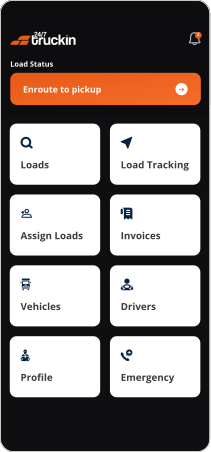
Understanding freight rate determinants becomes far more actionable when supported by the right technology. Platforms like 24/7 Truckin provide tools that improve visibility, coordination, and decision-making across the freight lifecycle.
By offering real-time load access, market insights, and operational tools, digital platforms enhance freight rate transparency and support data-driven pricing decisions.
Shippers, brokers, and owner-operators gain the ability to compare opportunities, optimize routes, and respond effectively to changing market conditions.
Rather than guessing why rates move, users can see the determinants in action and adjust their strategies accordingly. Contact us to learn more.
Making Freight Rate Determinants Work in Your Favor
Freight pricing is shaped by far more than distance alone. Freight rate determinants reflect a complex interaction of market forces, operational costs, regional dynamics, and technology.
Each rate applied to a shipment represents the combined effect of multiple variables working together, rather than a simple per-mile calculation.
Businesses that understand this reality are better positioned to plan effectively, control costs, and reduce exposure to unpredictable pricing shifts.
One of the most valuable outcomes of understanding how freight pricing is formed is improved planning accuracy. When organizations recognize how market conditions influence pricing, they are no longer caught off guard by sudden increases.
Factors such as shifts in supply and demand, changes in capacity availability, and seasonal demand cycles all contribute to rate movement. By tracking these influences, companies can anticipate tighter markets, adjust shipping schedules, and secure capacity earlier.

This forward-looking approach helps stabilize transportation budgets and reduces reliance on last-minute spot pricing.
Clear understanding of pricing drivers significantly improves cost management. Fuel costs, equipment availability, driver compensation, insurance, and maintenance requirements directly influence transportation expenses. When these inputs rise, rates follow.
Businesses that monitor these underlying costs gain clarity on whether pricing changes reflect legitimate increases or negotiation opportunities.
Regional and lane-specific dynamics further shape how freight pricing behaves. Rates vary across locations due to differences in infrastructure, congestion levels, tolls, and freight flow imbalances.
Certain lanes experience persistent pricing pressure because outbound demand consistently exceeds inbound capacity. Companies that analyze these patterns can redesign routes, consolidate shipments, or shift volume to more balanced lanes when possible.
Over time, these adjustments lead to more efficient network planning and better cost control.
The ability to navigate different pricing models is another advantage of understanding freight rate behavior. Long-term agreements offer stability, while short-term market pricing reflects real-time conditions.
Each model responds differently to market changes, and knowing when to rely on one over the other can protect margins and service levels. During volatile periods, informed businesses adjust their approach instead of allowing unfavorable pricing decisions to dictate outcomes.
Technology has become a key enabler in transforming pricing knowledge into action. Digital platforms now provide visibility into current market conditions, lane performance, and pricing trends.
With access to real-time data, businesses can evaluate opportunities more accurately and respond quickly to changes. Predictive insights allow teams to plan shipments around anticipated demand shifts rather than reacting after prices have already moved.
This level of visibility strengthens decision-making and reduces uncertainty across transportation operations.
Ultimately, understanding freight rate determinants changes how organizations approach logistics strategy. Businesses can analyze, plan for, and optimize pricing instead of treating it as a fixed cost.
Teams can align operations, procurement, and financial planning around shared insights, leading to more consistent and informed decisions. Stronger planning, better negotiations, and improved adaptability follow naturally.
By aligning knowledge, data, and execution, freight rate determinants become a practical advantage rather than a source of uncertainty.